

Chris Pratt's new movie, Mercy, is bad. There is no avoiding that fact. However, it isn't nearly as bad as many people make it out to be. While, at first glance, it seems akin to Ice Cube's War of The Worlds from last year, it turns out to be much more complex and layered, even though it isn't hard.
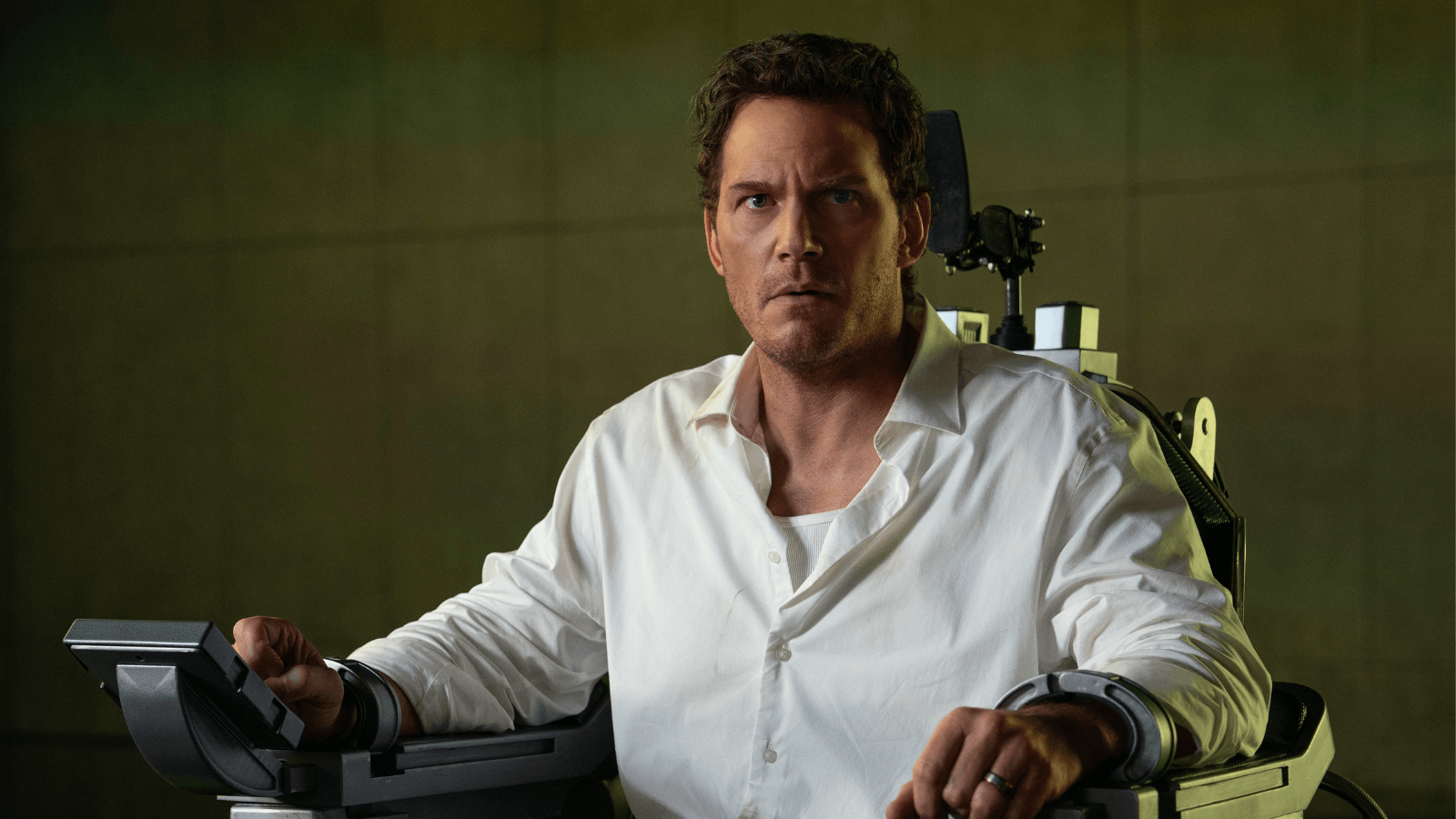
First off, why does this feel so familiar to War of The Worlds and what makes it different? Well, the easiest and, from my perspective, only tether between these two movies is their 'bottle episode' styles. However, Mercy does this style in a much more compelling way, actually giving meaning to it, unlike War of The Worlds. This movie has Chris Pratt strapped to a chair, in the middle of an empty room, as he is accused of the murder of his wife. He has 90 minutes to defend himself against an AI judge. A meaningful difference between this movie and War of The Worlds - aside from the obvious, in the general story - is that it's actually somewhat interesting. This case, and the depth that they go into investigating it, while possibly getting a little convoluted at times, was quite easy to follow without feeling like it's holding your hand, as well as allowing you to get engrossed in the story.
Another big difference is that Chris Pratt, as opposed to Ice Cube, can be a compelling leading man. This movie, due to the fact that the main character is strapped to a chair the entire time, doesn't allow for really any physicality. That then fell onto Chris Pratt to sell his performance, using only his face - like the opposite of a superhero performance like Spider-Man or Deadpool. While Chris Pratt may not have executed this perfectly, you can definitely feel a good amount of the emotions that his character would be feeling. The problem with big Hollywood actors is that, when they're in any movie, its almost impossible to see them as that character. Whatever role Chris Pratt is playing, you'll always see him as Star Lord (Guardians of The Galaxy) or Owen Grady (Jurassic World) or even just Chris Pratt. It also definitely doesn't help that his character in Mercy is also named Chris. My point here is that, no matter how well he acts, he can never disappear from the actor into the character. However with the cards he is dealt, Chris Pratt is able to sell this movie to a passable degree.
One thing I really did like about this movie was its decision to occasionally have the action completely surround Chris. This was a very good way to feel as if the audience, and the character himself, are a part of the action, rather than simply onlookers. This ups the stakes massively, as it feels like what we're seeing is actually a part of the world our main character is living in. It essentially has the same goal as a 3D movie, just without everything that makes 3D movies undesirable. One especially compelling use of this that really sticks in my mind was the scene where the bomb explodes at Rob's house and kills the SWAT team. Having the fire and debris fully engulf this room made it feel so much more real. It felt as if we actually knew these characters and it all felt much more menacing and dangerous than simply seeing it on a screen.
My biggest complaint with this movie isn't really the worst thing about it, however it is a detriment to how it's perceived. That is that it can't seem to decide on any real world opinions. There are two main things that this movie depends on, law enforcement and AI. These are both things that are very prominent in the real world right now and its important that art takes a stance on that. However, this movie kept flip flopping between its opinions on AI and law enforcement all throughout, to the point where it became much less compelling. The most in-your-face example of this was its opinions on law enforcement. The existence of the Mercy program implies that, at some point, this movie would take a stance that law enforcement shouldn't hold that much power, as well as Jaq Diallo also being an example of corruption within law enforcement. However, it seems like they kept trying to paint Chris as 'one of the good ones', despite him being a strong advocate for the Mercy program, all the way until it actively affected him. Despite the film's numerous attempts to force us to, I simply didn't want to root for this main character.
One thing I did love, however, was that Judge Maddox was completely impartial, being an AI judge with no capacity for feeling - at least at the start. However, throughout the movie Chris was somehow able to very easily bypass its blockages and end up creating something that wasn't there, being emotions and opinions. Even if this judge was a machine learning algorithm, surely the programmers would create some sort of blockage that wouldn't be bypassed by simply persuading it. All Chris did was ask Maddox for its opinion and somehow was able to give them to it. This AI is incredibly flawed if you can persuade it to have opinions simply because, for both humans and programs, if you introduce the concept of opinions to them, their opinions will usually be completely shaped by you. Surely more people than just Chris have tried to ask for Judge Maddox's opinion, meaning this program should never work as intended.
A core concept in this movie is an ever present ticking clock, counting down how long Chris has left to defend his case. Not only is this a very interesting addition to the movie, but it's also a perfect length to be real time. Its exactly 90 minutes, so with about 15 minutes after he gets out, this movie would round out to be an hour and 45 minutes. This would mean we can see the entire case in full, how it would've played out in that world, with absolutely nothing taken out, allowing for the audience to also form their own opinions. This sounds amazing in theory, however there are two main problems. I actually ran my own little experiment while I watched this movie. When the clock started, I looked at my watch which said "17:01", however, the clock didn't end at 18:31, it ended at 18:16. Where did those other 15 minutes go? I have no idea. Why would you have a timer that is constantly in the background, that either skips or speeds up? And, no, I didn't look at the time when Chris was ruled innocent, 15 minutes before the clock ended. It was actually just after he got out of the room.
Chris being ruled innocent actually brings me nicely to the second problem with this ticking clock, which is that it ended up not really mattering too much. Chris was ruled innocent 15 minutes before the end of the timer, it only kept counting down because he decided to stay. Its shown that he could've left at any time, especially from the fact that when he does ask to be let go, his request is honoured immediately. So, they tried to keep tension that was no longer there, which somewhat ruined the stakes of Chris' life, which the whole movie, until the end, was riding on.
Finally, this movie was so unnecessarily convoluted. There were so many twists and turns within the final 15 minutes and many parts felt quite unresolved. Yes, Jaq was arrested for throwing away evidence that would have stopped the death of the first Mercy victim, however the movie abruptly ended immediately after that. We never got to see what happened to the Mercy program, whether that information caused it to be dismantled, or if everything continued without interruption. All these questions didn't need to be answered by the end, however I would've liked at least a small hint on the future of this world. With a movie that leaves you with questions, you should at least be satisfied with how it ended, just curious of the world after. However, when Mercy ended I just felt dissatisfied, thinking "that's it?". It was almost as if the writers didn't know where to take this world after this moment without going past the allotted runtime that their higherups undoubtedly gave them, so they simply ended it there, abruptly and unfinished.
To conclude, Mercy isn't a terrible film, however it does have many flaws and definitely can't be called a good film. Too many ideologies are mixed into no opinion at all, some main components are executed badly or simply willingly altered, and too many plotlines are left unresolved, leaving you with a feeling of disappointment as you leave the cinema.
No AI was used in writing this article.