

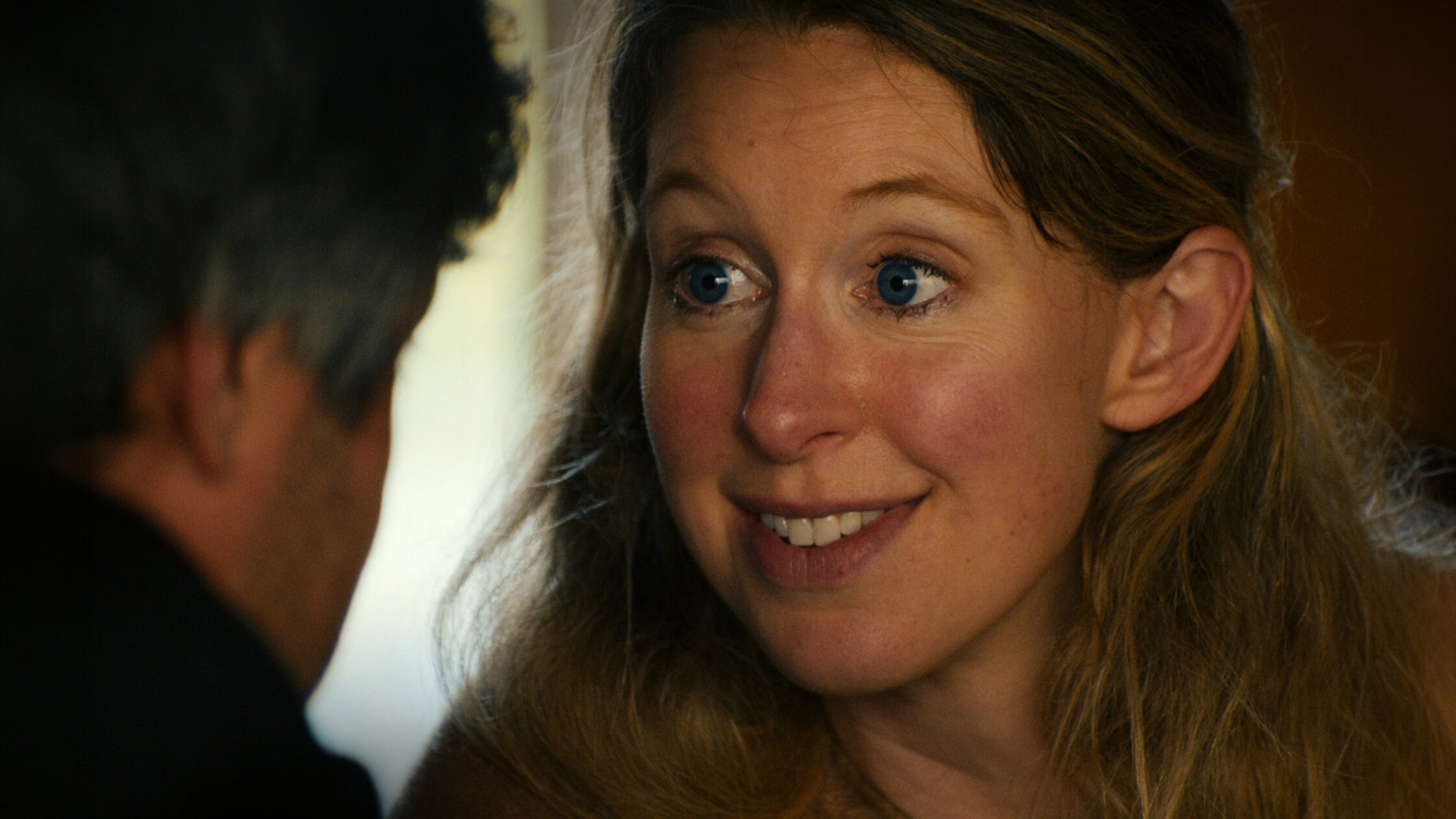
Spoiler warning: this review discusses key moments from the film.
I went into a press screening of You Can See Everything knowing almost nothing. No trailers, no reviews. Within minutes it clicked: Elizabeth Holmes. Theranos. That little rush of realisation is exactly why I'm glad I went in blind.
Nathan Fielder and Lance Oppenheim's A24 documentary starts 34 days before Holmes is due to report to prison, with Holmes and her partner Billy Evans allowing the filmmakers into their home. What begins with those 34 days becomes a three-year journey, and something I still find difficult to put into one category.
I walked out with my mind blown and genuinely not knowing what I'd just watched.
It's a documentary, obviously, but at different points it felt like I was watching a television drama, a film, a reconstruction, or something sitting somewhere between all of them. The lines of reality felt constantly blurred, but never in a way that made it messy. I was completely immersed.
Nathan was my point of reality
I'd never really watched Nathan Fielder before this screening.
He came out before the film and welcomed everyone, so my first proper introduction to him wasn't on screen. It was seeing him standing there in front of us. His awkwardness, the pauses, the way he spoke and responded to people all stuck in my head.
Then the film started, and the Nathan on screen behaved exactly like the person I'd just watched on stage.
When everything else started making me question what was real and what was being performed, Nathan felt like the one thing I could come back to. I kept thinking about the spinning top in Inception. He became my version of that, my little point of reference for reality.
There are moments where Liz becomes emotional and Nathan doesn't always react in the way you might expect. He can be very literal, awkward and almost detached. I actually think that works in his favour. It gives him some protection from being completely swept up in whatever is happening around him, even when you can see how easy it would be to get drawn into Liz's world.
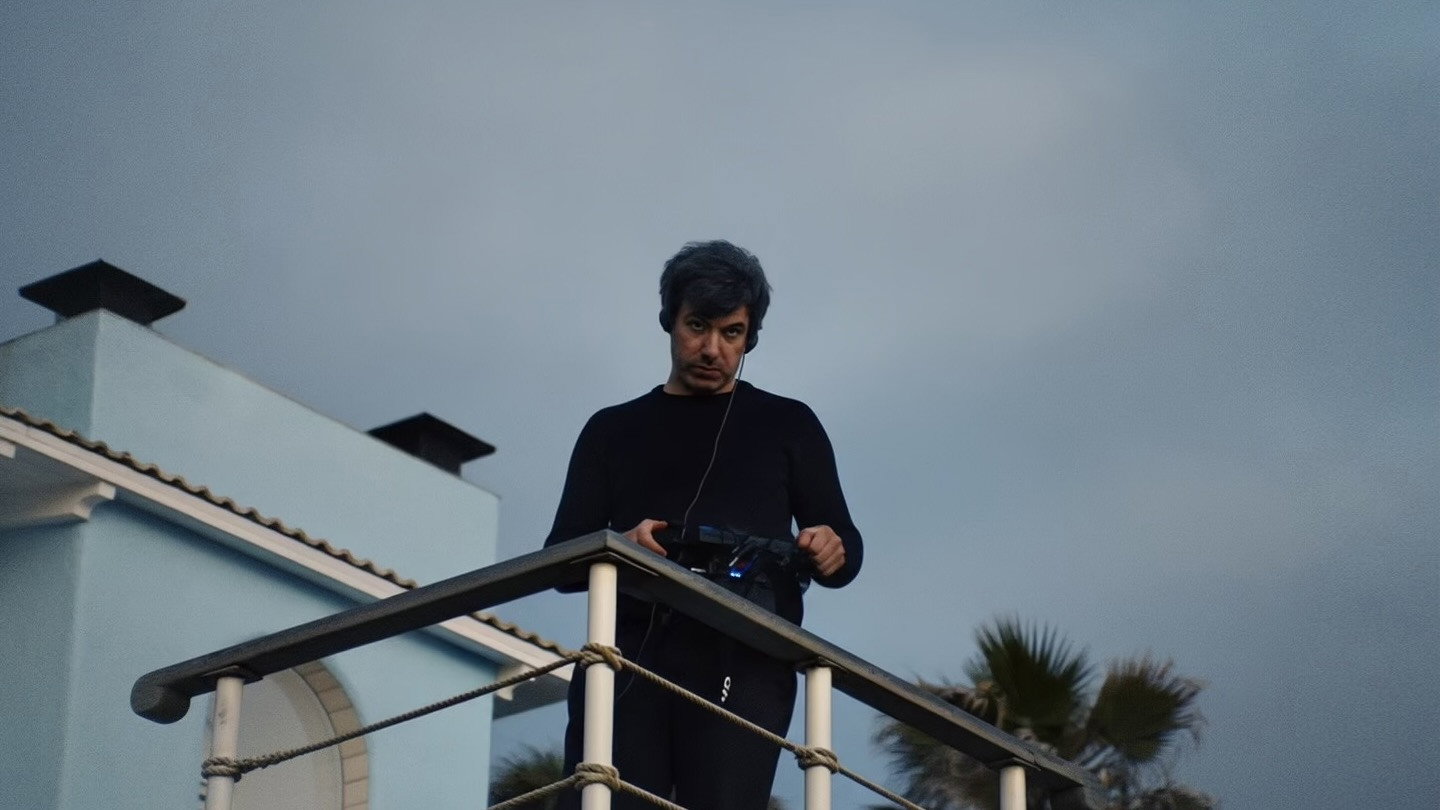
Who was I actually watching?
I came away believing Elizabeth Holmes was guilty. I also came away believing she's a very calculated and manipulative person.
But the film kept making me question how simple that judgement really was.
Early on, a line from a 2023 New York Times profile becomes important. Holmes was quoted as saying:
"They're not playing me. They're playing a character I created."
Holmes disputes the wording in the film and says what she actually meant was that they were playing a character they created.
That argument over one word stuck with me because it feels almost like the whole film in miniature.
Was she vulnerable, or was she in control? Was she being controlled?
There were moments where I felt sorry for her and wondered whether she was being manipulated, both in the relationship we were watching and possibly in relationships before it. Then I'd catch myself and think, no, is she manipulating me into feeling that? At certain points I felt she might even be manipulating Nathan and the crew, and you can understand why they themselves seem unsure about what they're being shown.
After almost three hours of access, did I actually know Liz any better?
I'm not sure I did. If anything, I probably understood why she's so difficult to read.
Amanda made it even harder to know what was real
Amanda Seyfried appearing in the film made the whole thing even stranger for me.
She played Holmes in The Dropout, so she'd already spent a huge amount of time studying her. Bringing her into this documentary makes sense on one level, but watching her step into this world adds another layer of uncertainty.
At points I knew she was studying Liz. At other points she seemed like she was simply being Amanda. Then I started asking myself the same question I'd been asking about Liz. Was this really her, or was I watching another performance?
One moment really stuck with me. When they were discussing Billy and Liz's relationship, Amanda said she wanted Liz to break up with him.
It was so direct I immediately wondered whether it was part of the construction. Nathan being there made it feel genuine to me, but the fact I was even questioning Amanda's authenticity by that point says a lot about what the film had done to my head.
She also made me pay much more attention to something I'd already started noticing: control.
There's a moment where Billy takes the yellow bowl of eggs away from Liz while she's whisking them because he wants it done his way. The first time I saw it, I noticed it, but it didn't seem hugely important. It was just one of those small domestic things people do.
As the film progressed, that moment started to change. You begin seeing more of that behaviour and a pattern starts to emerge. Then Amanda notices the same thing while rewatching the footage, and later, during the reconstruction in the house, she picks up the yellow bowl.
A small moment I'd almost moved past suddenly felt like an early glimpse of something much bigger. By the end of the film, the question of control doesn't feel subtle anymore.
None of that suddenly makes Liz innocent, and it doesn't turn her into a straightforward victim. She can be manipulative and still be manipulated herself.
The house felt like a box
From a CineMapper point of view, the locations were especially interesting because there aren't actually that many of them.
The house dominates the film, and Liz feels contained within it. So much of what we see happens inside those walls, and even visually it often feels enclosed. There doesn't seem to be a lot of natural light, and the way the house is filmed sometimes gives it an almost artificial feeling. Strangely, that made what I was watching feel more real rather than less.
You can also hear the sea from inside the house. I loved that. The outside world is right there, but it still feels slightly out of reach. It gives the house this dreamlike quality.
The more I watched, the more it started to feel like a physical version of the relationship itself. Everything is happening within a box, within certain parameters.
Then you look at Billy.
The locations we see away from the house are often connected to him. He goes to the gym. Later, after Liz is in prison, Nathan meets him at the WeWork office. They're ordinary locations, but together they give Billy a freedom of movement that Liz doesn't seem to have. He can move between spaces, work out, work, and present whatever version of himself fits that place.
Liz's world feels much smaller: the house, the beach around it, and eventually prison.
I don't think that automatically tells us what the relationship is, but once I noticed the difference in their movement, I couldn't really unsee it. For a film where so much revolves around control, it felt significant.
The craft is part of the confusion
What impressed me most is how well the film is put together.
The editing keeps pulling you backwards and forwards between what happened, what someone says happened, what someone remembers, and what is later reconstructed. The yellow bowl is a perfect example: the film keeps coming back to it until it means something else.
The reconstructions are where things become even harder to separate. Once Amanda is recreating Liz and Christopher Abbott is brought into Billy's side of the story, you're watching people perform people you've already been watching perform versions of themselves.
That sounds ridiculous written down, but somehow it works.
It's probably also why the runtime didn't bother me. I didn't feel like I was sitting through a nearly three-hour documentary. I was trying to keep up with it.
You can see everything, but can you?
The title didn't fully land with me until afterwards.
The cameras are there. Nathan and Lance have access. We see private conversations, domestic moments, emotional breakdowns and people trying to make sense of each other. You'd think that much access would make everything clearer.
For me, it did the opposite.
Even though you can see everything, you can't see everything.
I still believe Liz was guilty. I still think she's capable of manipulating people. But I also came away wondering how much she herself has been manipulated, and whether I understood some of the moments I watched in the way I thought I did.
That's why I don't think this is a film you watch once. If I watched it again, would the yellow bowl land differently now that I know where things go? Would I read some of those conversations differently?
Even when you think you can see everything, you're still only seeing what somebody has allowed you to see.
You Can See Everything is directed by Nathan Fielder and Lance Oppenheim, runs 174 minutes, and opens in UK cinemas on 20 November 2026 through A24.